Trimwise is for prompt assembly when an application already has a source and a question: keep the exact source passages most useful for that question inside a fixed output budget. This evaluation tests that scoped task. Each method receives the same source, question, and 128-, 256-, 512-, or 1,024-token ceiling.
Strict source-span results
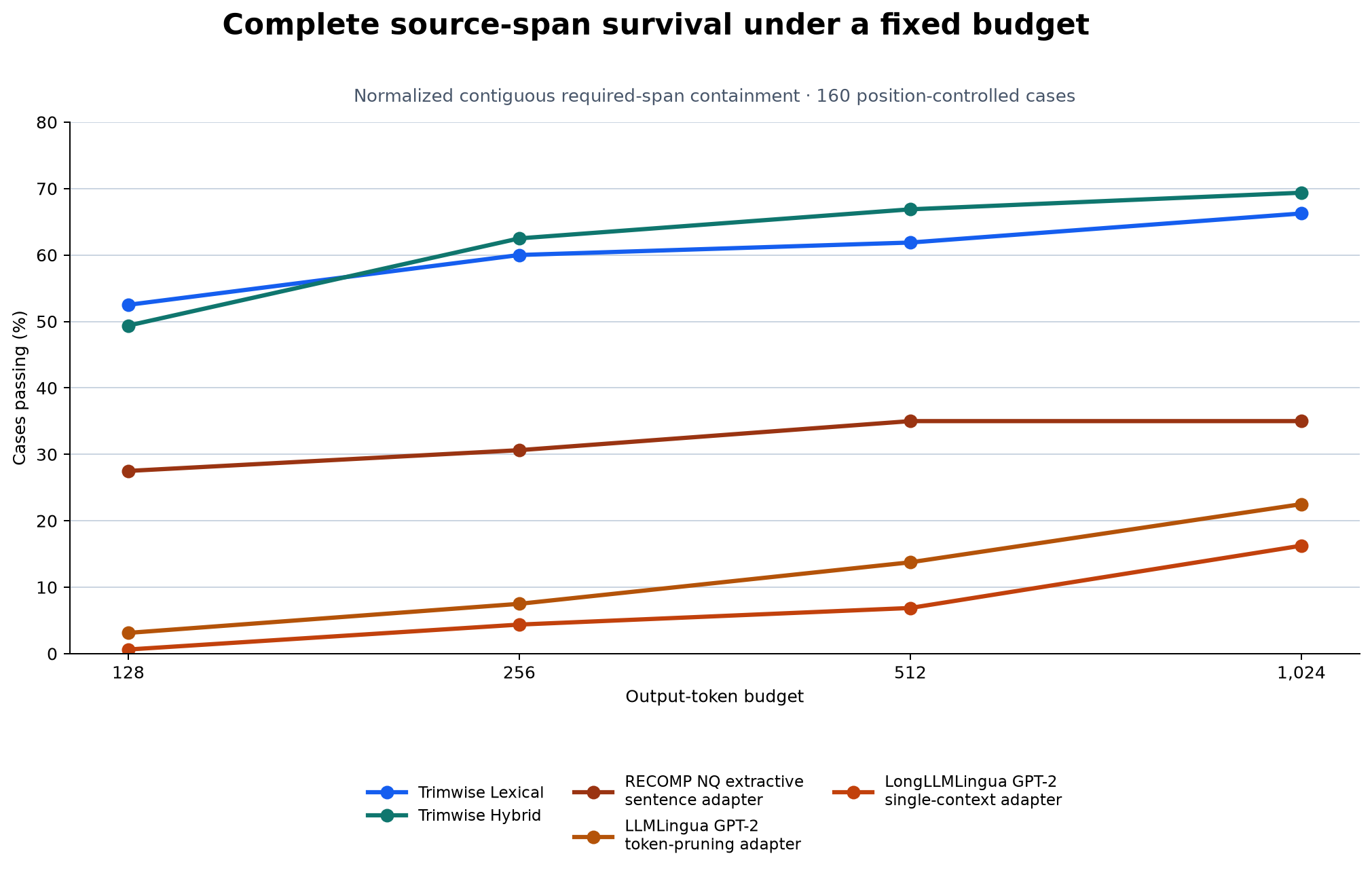
The v1.2 primary result is normalized contiguous required-span containment. A case passes only when every annotated source span appears as one contiguous passage after case-folding and whitespace collapse, prohibited text is absent, and the output fits the shared token counter. It measures complete survival of the annotated source evidence—not semantic sufficiency, answer quality, or general prompt-compression capability.
| Evaluated method or adapter | 128 tokens | 256 tokens | 512 tokens | 1,024 tokens | Median warm trim time |
|---|---|---|---|---|---|
| Trimwise Lexical | 52.5% | 60.0% | 61.9% | 66.2% | 6.4 ms |
| Trimwise Hybrid | 49.4% | 62.5% | 66.9% | 69.4% | 42.8 ms |
| RECOMP NQ extractive sentence adapter | 27.5% | 30.6% | 35.0% | 35.0% | 126.2 ms |
| LLMLingua GPT-2 token-pruning adapter | 3.1% | 7.5% | 13.8% | 22.5% | 168.0 ms |
| LongLLMLingua GPT-2 single-context adapter | 0.6% | 4.4% | 6.9% | 16.2% | 340.7 ms |
Open the detailed strict benchmark report.
Trimwise Lexical is the highest observed method at 128 tokens. Trimwise Hybrid is highest from 256 through 1,024 tokens. The two local ordered-retention sensitivity checks—80% and 90% ordered recall inside one reference-length output window—preserve that ordering at every tested budget.
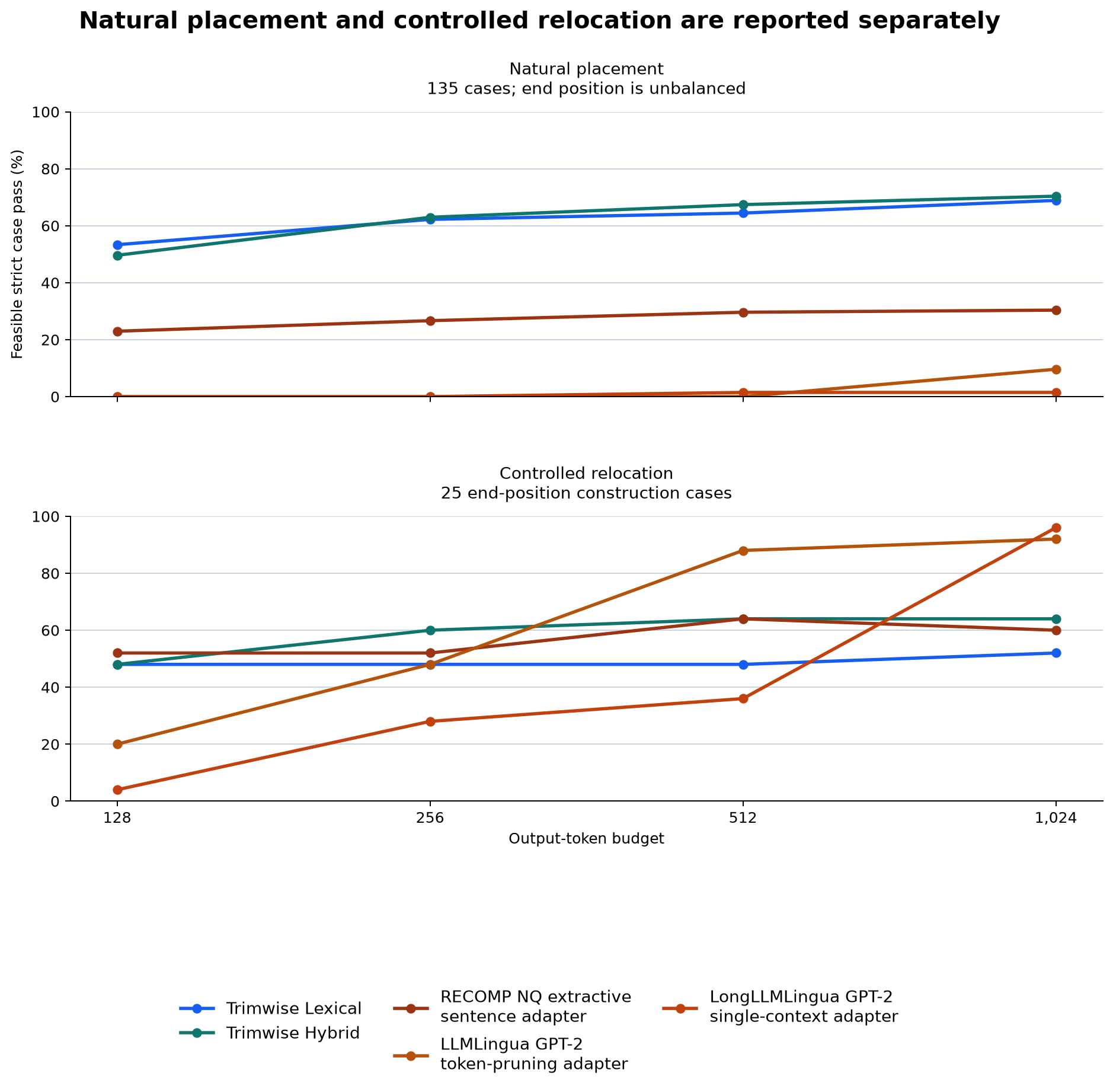
The report also separates the 135 natural-placement cases from the 25 controlled end relocations. On the natural-only sensitivity, Hybrid passes 63.0% at 256 tokens against 26.7% for the RECOMP NQ extractive sentence adapter; its 70.4% versus 30.4% result at 1,024 tokens has the same ordering. That natural subset is not position-balanced because it contains only 15 natural end cases. A separate 150-case sensitivity removes every source excerpt taken from Trimwise itself; Hybrid still passes 63.3% at 256 tokens and 67.3% at 1,024 tokens.
What this result means
The strict metric was specified after a review found that the original scorer could credit bag-of-token matches scattered across an output. The v1.2 protocol was frozen before the new aggregates were inspected and re-scores the same saved compressor outputs; it does not rerun a GPU model or an API evaluator. It is a post-hoc robustness analysis, not a new independent experiment.
The full sensitivity CSV includes normalized contiguous containment, local ordered 80% and 90% case pass, continuous local ordered recall, exact byte containment, and the earlier bag-of-token metric. The older metric remains available for historical reproducibility only; it is not the headline result on this page.
Budget compliance and speed
Trimwise Lexical and Hybrid and the RECOMP NQ extractive sentence adapter recorded no measured budget violations under the shared counter. The LLMLingua GPT-2 token-pruning adapter exceeded its requested ceiling in 30.6% of query-aware calls; the LongLLMLingua GPT-2 single-context adapter did so in 55.8%. Warm timing excludes cold model loading and thermal cooldown, and is specific to the recorded GPU and software environment.
Downstream answer diagnostic
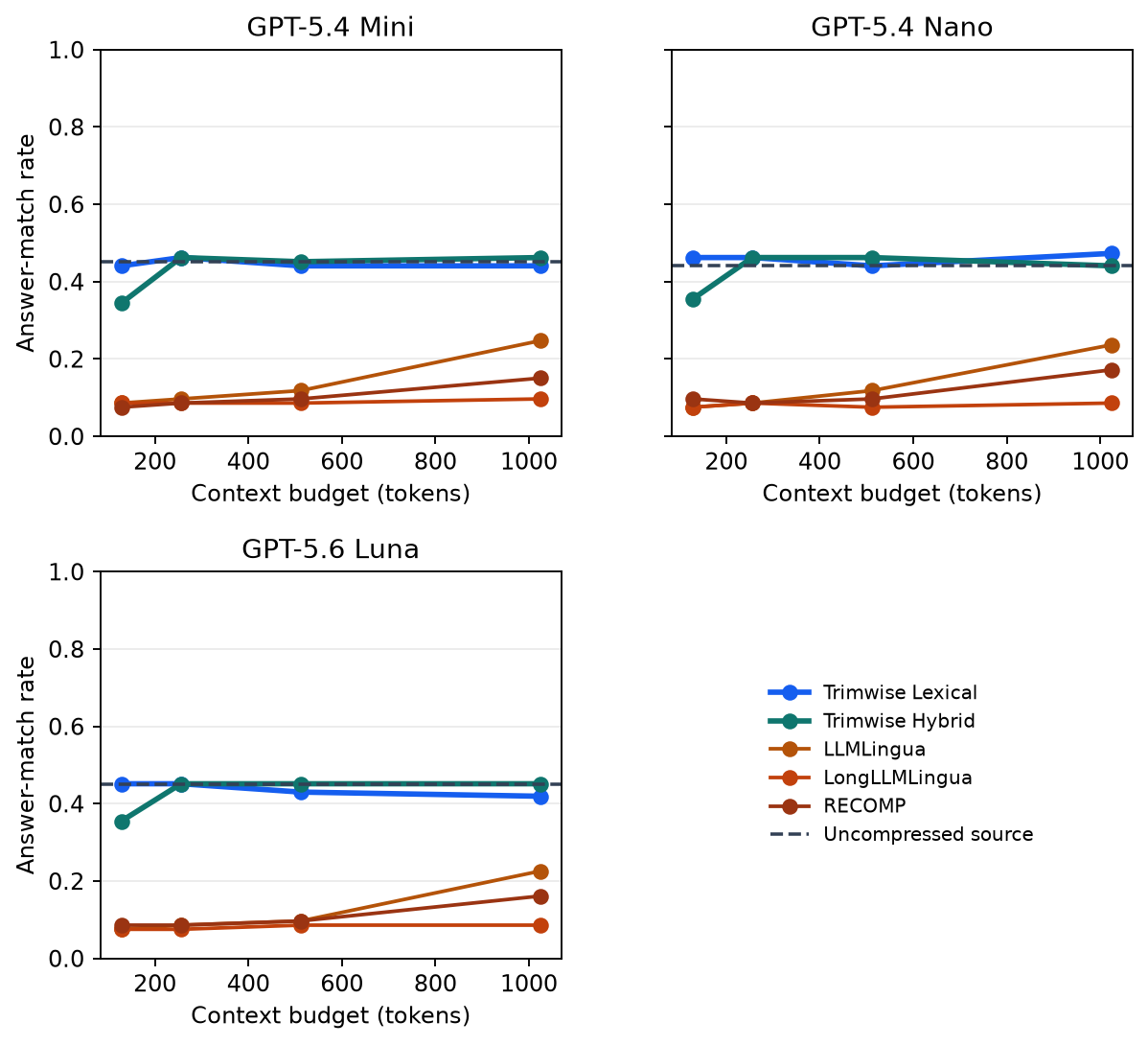
The saved benchmark also asks whether a compressed context can support a short answer. This is a separate, weaker diagnostic over 93 answerable cases with one continuation per context from GPT-5.4 Nano, GPT-5.4 Mini, and GPT-5.6 Luna. It uses normalized answer matching; it is neither a human correctness study nor proof that a model relied only on the context.
| Downstream evaluator | Full source | Trimwise Hybrid at 256 tokens |
|---|---|---|
| GPT-5.4 Nano | 44.1% | 46.2% |
| GPT-5.4 Mini | 45.2% | 46.2% |
| GPT-5.6 Luna | 45.2% | 45.2% |
Scope and limits
This is an author-annotated, position-controlled 160-case suite: 40 cases each with evidence at the beginning, middle, end, or multiple locations. It combines 135 natural placements with 25 source-preserving end relocations. A natural-only sensitivity analysis excludes the relocations; its end stratum has only 15 cases, so it is not position-balanced.
The comparison is against the exact adapters named above, not every configuration in the LLMLingua, LongLLMLingua, or RECOMP families. The RECOMP NQ extractive sentence adapter is built around the released checkpoint, not a reproduction of RECOMP's full retrieval and training pipeline. The relocation cohort is a source-preserving construction diagnostic: moving evidence also changes its neighboring text and the remaining source composition, so it is not interpreted as a pure causal effect of position. These results do not establish performance for every language, document type, private corpus, production agent workflow, or downstream model.
Reproduce or inspect
The frozen rows, dataset, method configuration, runtime information, source hashes, and scripts are public. The v1.2 manifest records the exact input identities and the scorer/protocol commit; the summary is sufficient to inspect every reported metric without making GPU or API calls.
- Benchmark protocol and reproduction commands
- v1.2 metric protocol
- v1.2 frozen input manifest
- v1.2 complete sensitivity summary
- v1.2 natural-only sensitivity
- v1.2 self-source-excluded sensitivity
- v1.2 paired bootstrap intervals
- Historical v1.1 report and source-only diagnostic
- Versioned paper and PDF
For the selection methods behind these results, see Research Foundations.